Please save the date!
The mid-term meeting for the New Forest Commoners’ Defence Association is being held at 7.30pm on Friday, 14th November at Bramshaw Village Hall (SO43 7JE).
The meeting is open to all New Forest Commoners and there will be cake, tea and coffee as well.
Speakers to be confirmed in due course.
Pig farmers in the New Forest are encouraged to attend an expert advice workshop with a local vet.
Alex Crook, from Pilgrims Vets in Fordingbridge, will be holding a question and answer session at Storm’s Farm in Cadnam on Tuesday, 9 September.
The event is primarily for New Forest Commoners who own pigs, but also those who have an interest in turning the animals out.
It is being funded by the Verderers of the New Forest Higher Level Stewardship scheme, which helps to support Commoning in the Forest through various initiatives, and is being run by the New Forest Land Advice Service.
The Service provides independent land management advice across the New Forest and Avon Valley and is a partnership of the NPA with Hampshire and Isle of Wight Wildlife Trust.
The workshop – which includes a free barbecue – runs from 1.30pm until 4pm.
Sign up for free on the Eventbrite page although places are limited
Pannage season – the practice of Commoners turning out pigs in the Forest – starts this month. The pigs forage for acorns, nuts and other food from the Forest floor.
Acorns can be poisonous to ponies and cattle if consumed in large amounts.
Looking for the perfect summer evening filled with live music, great food, and a warm community spirit? Then Folk on the Farm Festival is the place to be!
Enjoy an evening of folk tunes with country vibes, delicious food and plenty of fun at Storm’s Farm in Cadnam.
The event starts from 6.30pm on Saturday, 4 October.
The music line-up includes performances by Blacksmith, Itchen Privateers and DJ Billy Allen, while proceeds from the festival will go towards Brockenhurst Young Farmers and Hampshire and Isle of Wight Air Ambulance.
The event is sponsored by New Forest-based New Park Consultancy, which provides rural property advice across Hampshire, Wiltshire, Dorset and the Isle of Wight.
Tickets for Folk on the Farm Festival are just £10 per person, while it is free entry for under 16s.
For more information and to purchase tickets, head to the Folk on the Farm Festival Eventbrite page

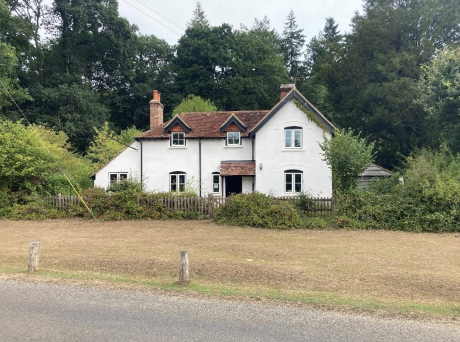
A Forestry England property in Linford has become available to rent for New Forest Commoners from this autumn.
Linford Cottage near Ringwood is a three-bedroom detached house with a garden and small outbuildings backing directly onto Little Linwood Inclosure.
The rent is £1,098.44 per calendar month (fully subsidised Commoning rent).
The deadline to submit an application of interest in the property is Wednesday, 10 September.
Viewings are by appointment only.
For more information about the property itself and to fill in an application form, please see the links below.
Further information
For any other questions or queries, please email Fergus Robertson-McIsaac at Forestry England: fergus.robertson-mc@forestryengland.uk
Every autumn, the New Forest comes alive as the free-roaming ponies, cattle and donkeys are rounded up as part of Drift season.
The Drifts, which take place over several months, form an essential part of Commoners’ lives and how they manage their livestock and offers a glimpse into the living heritage of the New Forest.
What are the Drifts?
The Drifts are carefully coordinated events where agisters, supported by Commoners and other helpers, gather animals from across the Forest into temporary enclosures known as pounds.
The work is done on foot and on horseback, and follows set routes that have been used for generations.
The term ‘drift’ comes from the way the animals are steadily moved or ‘drifted’ across the open landscape and into the pounds. Once there, each animal is checked and dealt with as needed before being turned back out onto the Forest.
Why do the Drifts take place?
The Drifts take place for a number of reasons, primarily:
- Health checks – Animals are inspected to ensure they are in good condition. Any that are unfit can be treated or removed from the Forest
- Welfare management – Foals are branded with their owner’s mark, and some animals may be wormed or vaccinated
- Stock control – Commoners can limit the numbers of animals they turn out by selling, resting or keeping them in over the winter
- Conservation balance – By managing numbers and health, the drifts help ensure grazing levels remain sustainable for the unique habitats of the New Forest
Advice to the public
It is important to remember that managing the Drifts is hard and necessary work.
For safety reasons, members of the public are asked to keep well clear of Drift routes and pounds, and to give working riders and animals plenty of space.
Safeguarding a living tradition
The Drifts embody the partnership between the New Forest, its landscapes, its wildlife, and the Commoners who continue centuries-old rights of grazing.
Without them, the health of the animals – and the balance of the Forest itself – could not be maintained.
Find out more
To see a full list of upcoming car park closures for the Drifts, head to the Forestry England website
Please note dates can change at short notice due to operational reasons.
Announcements will also be made on the New Forest CDA’s Facebook page
Two Commoners and members of the New Forest Commoners’ Defence Association have been recognised at this year’s New Forest Awards.
Organised by the New Forest National Park Authority and the Country Land and Business Association (CLA), the Awards – now in their 12th year – celebrate outstanding contributions to the Forest’s environment, heritage, and rural economy. With 2025 marking the 20th anniversary of the New Forest’s designation as a National Park, a special new accolade was introduced: the Commoning Champion Award.
Championing a living tradition: Andrew Parry-Norton
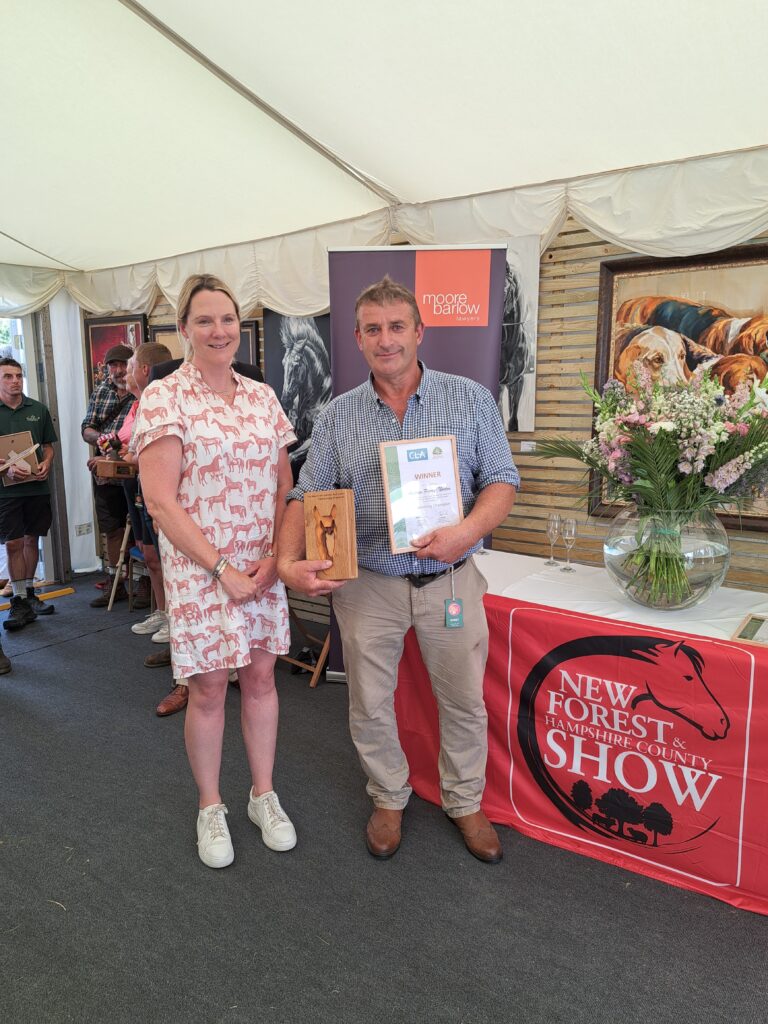
Andrew Parry-Norton with his award
The inaugural Commoning Champion Award was presented to Andrew Parry-Norton, chair of the New Forest CDA, acting chair of the Forest Farming Group, and a director of New Forest Marque and Go New Forest.
His influence reaches far beyond administrative roles; as he actively engages with schools, young farmers, and community groups to raise awareness about the importance of Commoning in modern conservation and rural life.
‘I am honoured and feel very privileged to have won this award,’ Andrew said. “I’m proud of every Commoner and the unique values and experience they bring to the practice. Anybody who continues to Common – amid the increasing pressures on the tradition – is worthy of recognition in my opinion. We are all striving to ensure Commoning is at the forefront of the New Forest’s future.’
Bridging agriculture and conservation: Ben Dolbear
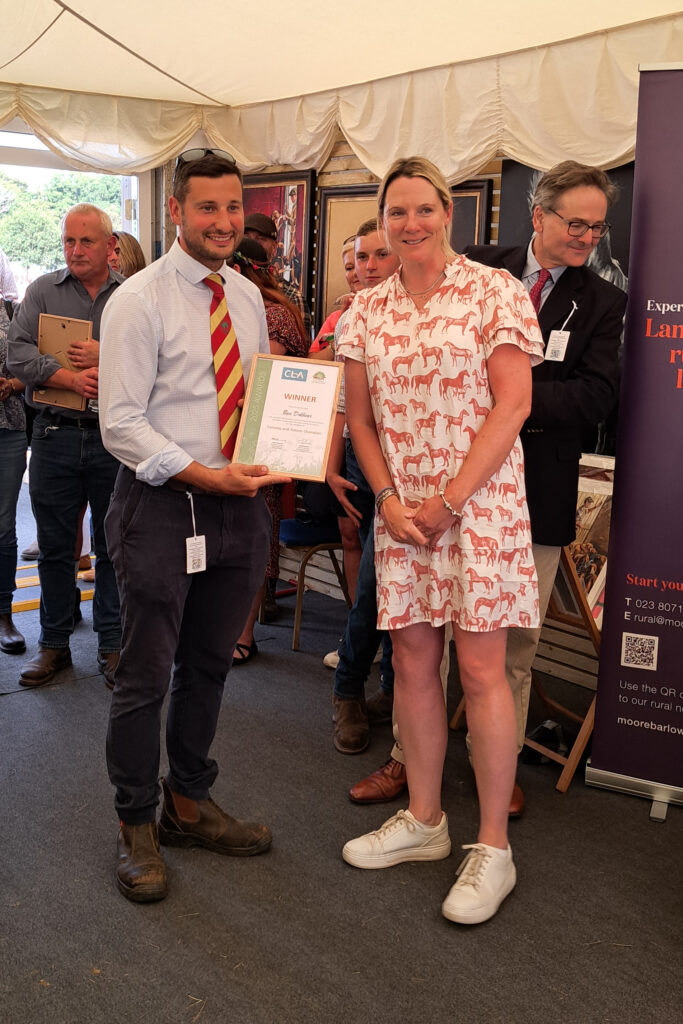
Ben Dolbear with his award
Fellow Commoner Ben Dolbear was honoured with the Farming and Nature Champion Award for his work at the intersection of sustainable agriculture and environmental stewardship.
As director of Bright Seeds, Ben works with farmers and landowners to develop pollinator-friendly and conservation-focused seed mixes, while continuing to operate his own farm with strong environmental principles. A recent carbon audit of his farm has enabled him to make targeted improvements, further enhancing wildlife corridors and biodiversity across the holding.
Ben’s passion extends beyond the land: he is a committed advocate for public understanding of sustainable farming, regularly engaging with non-farming audiences to communicate the vital role of agriculture in environmental health.
‘I am privileged to accept this award on behalf of everyone who cares about the countryside and farmed environment,” said Ben. “Farming and conservation are natural bedfellows: you cannot be passionate about one without the other.’
‘A valuable contribution to the Forest and its economy’
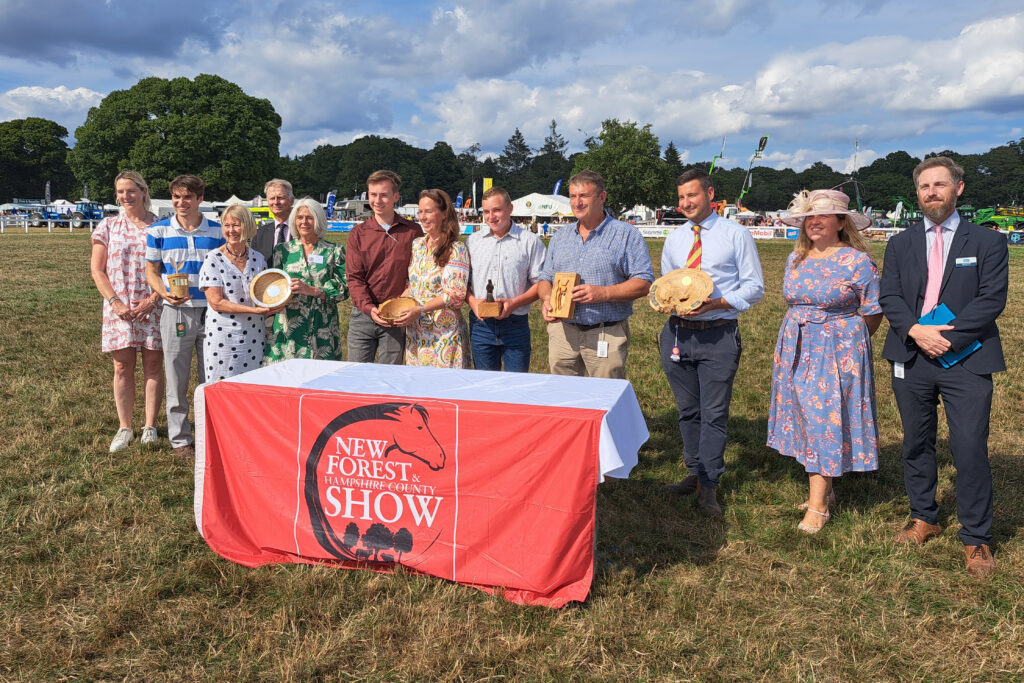
New Forest Awards winners 2025 including Andrew Parry-Norton (fourth from right) and Ben Dolbear (third from right)
The Awards, supported by Moore Barlow and the New Forest Agricultural Show Society, were presented at a ceremony at the New Forest Show last Wednesday afternoon. Trophies were handed out by 2025 New Forest Agricultural Show Society President, Lord Willie Manners.
Alison Barnes, chief executive of the New Forest National Park Authority, said: ‘We’re proud to recognise the dedicated people who shape and support this extraordinary place. It takes a whole ‘Team New Forest’ to ensure the long-term survival of the National Park, and our winners really are best in class.’
Tim Bamford, CLA South East Regional Director, added: “The CLA congratulates all the deserving winners who make such a valuable contribution to the Forest and its economy.”
For more on the Awards and to see the full list of winners, head to the NPA website
Entries are officially open for the 2025 New Forest Pony & Cattle Breeding Society Annual Breed Show – and once again, the spotlight is on the cattle classes, an essential and long-standing part of the Show’s heritage.
While the main Breed Show continues to showcase New Forest ponies, the cattle classes have carved out their own legacy over the decades. Although no longer judged at the showground itself, cattle classes remain a central part of the event and are judged in advance either on competitors’ holdings or directly out on the open Forest.
This year’s schedule includes six main classes for:
- Forest-run and non-Forest-run cattle
- Youngstock
- Cattle sired by native breeds
- A Forest Run Championship
- Special recognition for Best Young Commoner
New for 2025: Commoners Beef Herd Class (C7)
The Society is especially proud to introduce a new class this year in memory of Matthew Gerrelli, a dedicated supporter of the Society, the cattle classes and former cattle champion. The ‘Commoners Beef Herd’ class (C7) honours his contribution and encourages participation from practising commoners.
- Open to practising Commoners in 2025
- Minimum of three cattle, any breed or age
- At least one entry required in class C1 or C2
- Judged alongside C1 and C2
- Winner receives the Beechwood Cup
Entries close on Monday, 18 August, with the provisional judging date being Thursday, 21 August.
- Cattle Classes schedule
- Online entry form
- Download a manual entry form – these can be returned by e-mail or post.
The New Forest CDA is encouraging all practising Commoners to take part.
Whether you’re entering a single animal or a whole herd, these classes are your chance to showcase your breeding, care, and commitment to keeping New Forest heritage alive.
For questions or support with entry forms, please contact the New Forest Pony Breeding and Cattle Society office or visit the Society’s website
A bumper acorn crop is expected across the New Forest this year.
As a result, Forestry England and The Verderers of the New Forest have confirmed the 2025 pannage season will take place between Monday, 15 September and Friday, 28 November.
However, these dates are subject to change as an extension could be agreed later in the year.
What is pannage?
Pannage is the traditional practice of turning out domestic pigs into woodland to forage for fallen acorns, beech mast, chestnuts, and other nuts. This is more than just a tradition as it plays a vital role in maintaining the ecological balance of the Forest.
While acorns are a natural and nutritious food source for pigs, they are toxic in large quantities to other grazing animals such as ponies and cattle. Allowing pigs to clear the Forest floor helps protect the health of other livestock and continues a practice that dates back centuries.
Important reminders for Commoners
- Pigs must be inspected and marked by their area agister at least 14 days before being turned out
- Property owners adjacent to the open Forest are reminded that it is their responsibility to fence out Forest animals, including pigs. Standard fencing for ponies and cattle may not be sufficient to deter pigs, so check your boundaries carefully
Need more information?
If you have questions or need assistance regarding the 2025 pannage season, please contact:
The Verderers’ Office
The King’s House
Lyndhurst, Hampshire
SO43 7NH
Tel: 02380 282052
A new initiative is underway to explore whether New Forest Commoners could be formally recognised as a minority group.
The primary purpose is to help protect Commoners’ unique cultural heritage, land-based traditions and way of life for generations to come.
As part of the early-stage work, the New Forest Commoners’ Defence Association (CDA) is launching a simple two-question survey to gauge support and visibility of the proposal within the Commoning community.
The survey aims to understand how many people identify as Commoners both now and potentially in the future. The survey comprises the following yes/no questions:
- If you had known it was an option, would you have identified as a New Forest Commoner in the most recent national census?
- If it becomes an option, would you identify as a New Forest Commoner in future national censuses?
It is hoped the results will demonstrate the scale and commitment of the Commoning community while supporting the case for recognition in public records and policy.
Chair of the New Forest CDA, Andrew Parry-Norton, said: ‘The purpose of this short survey is cultural visibility.
‘Commoning is a way of life deeply tied to the landscape, with roots going back hundreds of years. But unless we’re counted we are at risk of being overlooked.’
The results of the survey will inform wider discussions with policymakers, heritage bodies, and other minority communities in the UK who have achieved formal recognition.
Anyone who considers themselves a New Forest Commoner is encouraged to take part and share the survey widely within the community.
Take the survey here
Read the introductory report by Brice Stratford: Recognising New Forest commoners as a national minority
The deadline to complete the survey is Sunday, 31 August.
Visitors to this year’s New Forest Show are warmly invited to stop by the New Forest Commoners’ Defence Association (CDA) stand, to learn about one of the Forest’s oldest and most vital traditions: Commoning.
The CDA stand, run by the committee and Young Commoners committee, offers a rare insight into the world of the New Forest Commoners – those who have grazed their animals on the open Forest for generations and played a crucial role in preserving its unique landscape and way of life.
Throughout the Show, which takes place between Tuesday, 29 July and Thursday, 31 July, commoners will be on hand to chat, answer questions and share their knowledge to the wider public.
It will be a fantastic opportunity to hear first-hand about the challenges and rewards of Commoning in the New Forest, how it shapes the Forest today, and why its future depends on continued public support and understanding.
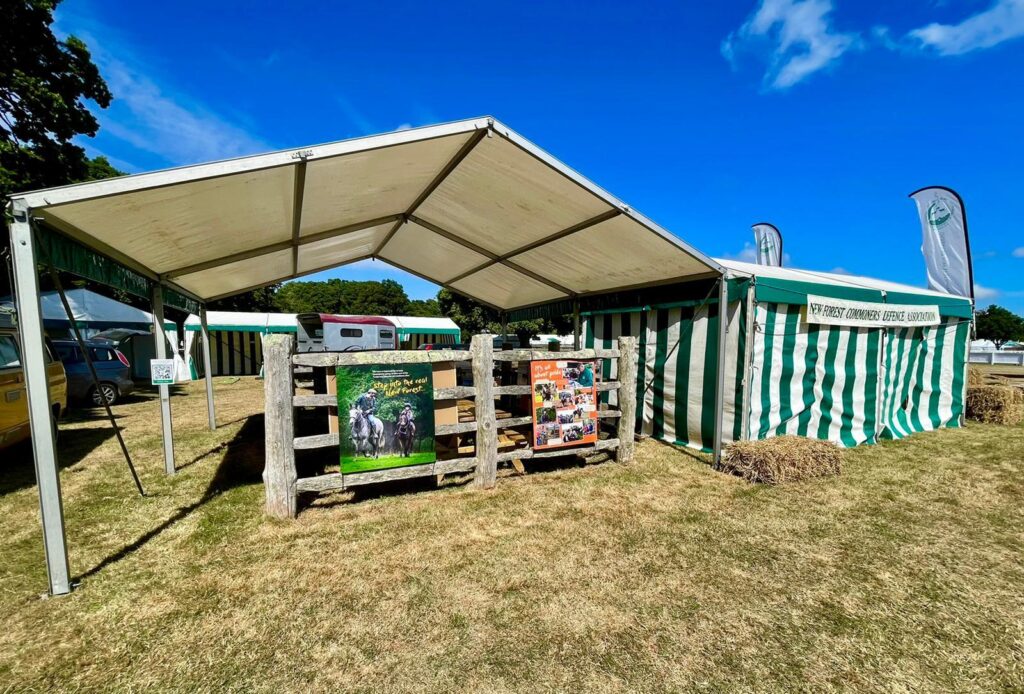
New Forest CDA Stand at the New Forest Show
From learning about livestock and traditional rights to understanding the threats facing Commoning in a changing world, the CDA stand will be informative, engaging, and family-friendly.
There will also be a chance to purchase a bespoke wooden plaque made at the Show by Commoners. Proceeds from the sales go towards the CDA and Young Commoners.
Find the New Forest CDA stand in the New Forest Corner area at the Show.
Members Login
 Latest Tweets
Follow us

@realnewforest 4h
Icilibus sam quas aut eriatem nume corepta auta conet officaborem quodi corepta auta conet officaborem quodi apernat ectlpa dolorpiaecus.
@realnewforest 4h
Icilibus sam quas aut eriatem nume corepta auta conet officaborem quodi corepta auta conet officaborem quodi apernat ectlpa dolorpiaecus.
@realnewforest 4h
Icilibus sam quas aut eriatem nume corepta auta conet officaborem quodi corepta auta conet officaborem quodi apernat ectlpa dolorpiaecus.
 Join us on Social

Tag your images #RealNewForest
With thanks for support from