What is New Forest pannage?
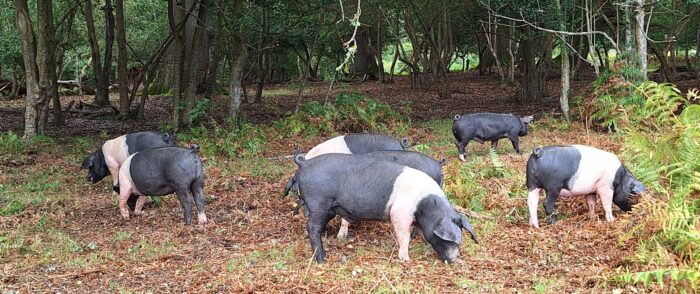
Pannage is the traditional common right to turn pigs out onto the New Forest to forage for fallen acorns, beech mast and other nuts.
It is one of the oldest commoning practices in the Forest and remains an important part of commoning today.
Each autumn, Commoners turn their pigs out to make the most of the natural food available on the Forest floor.
Why do Commoners turn pigs out for pannage?
Pannage gives pigs the opportunity to forage naturally on the Forest, particularly for acorns and beech mast.
It is also an important part of the traditional system of commoning. The right to turn out pigs is one of the historic common rights associated with the New Forest, and continuing to exercise these rights helps keep commoning alive.
Pigs are particularly well suited to eating acorns, which can be harmful to some other livestock if consumed in large quantities. Pannage therefore has an important role in helping to reduce the amount of fallen acorns available to ponies, cattle and other livestock.
When does pannage take place?
Pannage takes place during the autumn, when acorns, beech mast and other nuts begin to fall.
The timing and length of the season can vary, depending on conditions and the availability of mast.
The amount of mast also varies considerably from year to year. Some autumns produce a heavy crop of acorns, while others have much less.
Where do pannage pigs go?
There isn’t a set area where pannage pigs stay. They are turned out across the Forest and naturally move around as they search for food.
This means they can sometimes be found in unexpected places – including close to roads, car parks, villages and popular visitor locations.
Their movements can also change quickly depending on where the best food is available.
Why are pannage pigs sometimes close to roads?
Pigs follow the food, and oak and beech trees can be found alongside many of the Forest’s roads.
During pannage season, drivers should, therefore, expect to encounter pigs and other livestock close to, or even crossing, roads.
Please slow down and be prepared to stop. New Forest livestock can move unpredictably and have priority on the Forest’s roads.
Can I feed a pannage pig?
No. Pannage pigs should never be fed by visitors.
The pigs are out on the Forest to forage naturally. Feeding them can alter their behaviour and may encourage them towards people, roads or car parks.
It is particularly important not to encourage livestock towards roads by offering food.
Can I approach or stroke a pannage pig?
No. Pannage pigs are livestock belonging to New Forest Commoners and should be treated with the same respect as any other livestock.
Even if a pig appears calm or is used to seeing people, it should not be approached, touched or followed.
Give pigs plenty of space to forage and allow them to move away from you.
Why is pannage important to Commoners?
Pannage is a practical example of commoning continuing to take place on the Forest today.
The sight of pigs foraging beneath the oaks and beech trees is part of the traditional rhythm of the New Forest year, alongside pony Drifts, grazing and other commoning activities.
For Commoners, exercising common rights such as pannage helps maintain the living link between today’s Forest and the generations of Commoners who have managed livestock here for centuries.
Does pannage help the New Forest?
Pannage is part of the wider system of traditional grazing and livestock management that helps shape the New Forest landscape.
Most importantly, it is a working common right that remains relevant today. The continuation of practices such as pannage helps ensure that commoning remains a living tradition rather than simply something remembered from the Forest’s past.
What should visitors do if they see pannage pigs?
The best thing you can do is simply give them space and enjoy seeing them from a safe distance.
If you are driving:
- Slow down and be prepared for pigs to cross the road
- Expect livestock around bends and near car parks
- Give animals plenty of room
- Never sound your horn or try to move livestock yourself
If you are walking:
- Don’t approach, feed or touch the pigs
- Keep dogs under control and away from livestock
- Give sows and piglets plenty of space
- Let the pigs continue foraging without disturbance
Members Login
 Latest Tweets
Follow us

@realnewforest 4h
Icilibus sam quas aut eriatem nume corepta auta conet officaborem quodi corepta auta conet officaborem quodi apernat ectlpa dolorpiaecus.
@realnewforest 4h
Icilibus sam quas aut eriatem nume corepta auta conet officaborem quodi corepta auta conet officaborem quodi apernat ectlpa dolorpiaecus.
@realnewforest 4h
Icilibus sam quas aut eriatem nume corepta auta conet officaborem quodi corepta auta conet officaborem quodi apernat ectlpa dolorpiaecus.
 Join us on Social

Tag your images #RealNewForest
With thanks for support from