Do you know someone who makes an exceptional contribution to New Forest commoning? Then now is the time to get them recognised as part of the New Forest National Park Awards.
The annual awards, which is in its 12th year and run by the New Forest National Park Authority and the Country Land and Business Association (CLA), recognise outstanding contributions to the environment, rural economy and local communities in and around the National Park.
This year, as the New Forest National Park marks its 20th anniversary, a new award – Commoning Champion – has been introduced to recognise individuals playing a vital role in sustaining the unique practice which helps maintain the Forest’s landscape and biodiversity.
To be nominated for the Commoning Champion category, the following criteria must be met:
- Demonstrates sustainability and regenerative farming in the context of the New Forest as well as responsibility for, respect and care of the New Forest landscape
- Demonstrates support for the commoning community – for example as member of the CDA and/or the New Forest Marque, attending the Verderers Court, supporting/attending drifts
- Demonstrates a commitment to public education
- Has a strong commitment to high welfare standards and practices, overall condition of cattle and ponies
- Has a management plan for the holding and improvement of livestock
- Contributes to the management of the interaction between visitors and his / her stock
- Demonstrates an understanding of the history of commoning and the Forest and the role of the different organisations in managing the New Forest landscape
Individuals can nominate themselves or be nominated by others. All nominees must live, work or operate within the New Forest Awards area.
The other categories are Sustainability Champion, Young Farmer (aged 35 and under), Best Supporter of Local Produce, Young Environmental Champion (aged 25 and under) and Farming and Nature Champion.
Winners will be announced at a special awards ceremony and drinks reception at the New Forest and Hampshire County Show on Wednesday, 30 July. The event is supported by Moore Barlow and the New Forest Agricultural Show Society.
Nominations close on Sunday, 8 June. Full criteria and nomination forms are available at www.newforestnpa.gov.uk/newforestawards
The New Forest CDA committee has been confirmed for the year 2025/26.
Andrew Parry-Norton has been re-elected as the group’s chair, with Keith Mansbridge replacing Robert Stride as vice chair.
The decisions were made at the CDA’s monthly committee meeting on Tuesday, May 6.
Andrew Parry-Norton said: ‘I am delighted to be re-elected as CDA chair. I will continue to fight for commoners in all areas and ensure our voices are heard so we have a bright future to look forward to.
‘And I would like to place on record my thanks for all the work Robert has done as vice chair. He has gone above and beyond to help commoners over the years and his support to me has been invaluable.
‘I am now looking forward to pushing on for 2025/26 and seeing the CDA go from strength to strength.’
The full committee for the year ahead can be viewed below.
2025/26 Committee
Mike Eccles (President), Andrew Parry-Norton (Chair), Keith Mansbridge (Vice Chair), Richard Deakin (Treasurer), Hilary Harper (Secretary)
Elected members: Mark Adams, Sami Blastock, Adam Coutts, Ben Dolbear, Erika Dovey, Sam Dovey, Fiona Gover, Kay Harrison, Tom Hordle, Bill Howells, Brian Ingram, Ben Mansbridge, Martin Pate (Hon Solicitor), John Pooley, Daisy Slocombe, Debbie Stokes, Robert Stride, Philip Stride, Tony Vanderhoek, James Young, Alex Crook (farm vet), Laura Trigg (equine vet)
Co-opted members: Jonathan Gerrelli, Robyn Loveless, Julian Pothecary, Anita Smith, Alice Rowe, James Young
This is a report on salt licks, signs and replacement fences in the New Forest, organised by CDA committee member Tony Vanderhoek. The report was first published in the CDA annual report for 2024/25.
Salt licks
The CDA salt lick project is now in its fourth season led by Bill Howells and myself.
After a trial over three winters up along the B3078 Cadnam to Fordingbridge with 17 salt licks sited, it was decided that we should now extend it to the B3054 Dibden to Beaulieu/Beaulieu to Lymington road.
The accident figures seemed to show a reduction in the B3078, with the highest number of accidents now along the B3054. We were a bit late in getting the salt licks out this year (24/25) as we had to renew the Forestry England licence and a risk assessment to include the B3054. This also involved a ‘recce’ along that stretch of road to figure out their best sites and how many we would need for FE to agree on before issuing the licence.
Thirteen more salt bins were needed, so Bill and I set to work sourcing old tyres that were the right size and buying the bowls, chain, shackles and bolts to finally putting them together them in Bill’s workshop. Once made, we put them out as soon as we could with the salt blocks. A total of 30 bins are now sited.
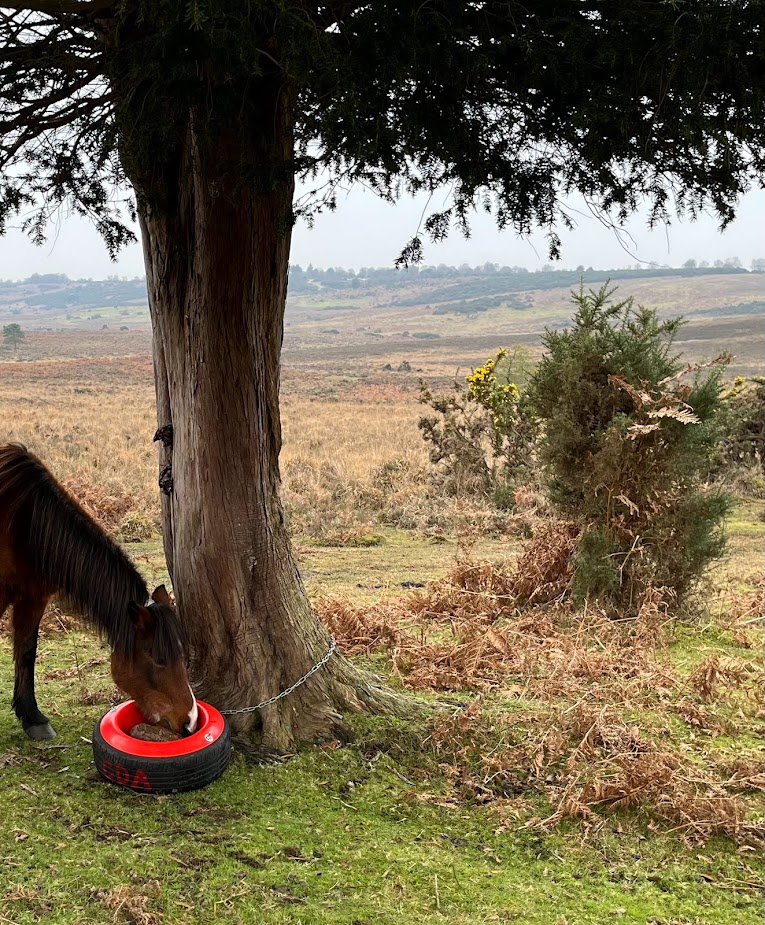
The salt lick scheme is one initiative trying to reduce the number of animal accidents
This attracted media attention and BBC South Today paid us a visit. This was aired on TV and on radio/social media at the end of January with valuable contributions from Gilly Jones and Hampshire Police highlighting animal awareness whilst driving through the Forest. All helpful stuff.
The good news is that 2024 had the lowest animal road deaths recorded. Let’s hope we can reduce the animal accidents even more with the combination of all the initiatives that we have ongoing in the Forest. We would like to add that The New Forest Trust are now kindly funding this project.
Signs
The CDA and has for several years organised the production of signs sited mainly at the Crown lands Forest car parks to try to prevent visitors from feeding, petting and generally to keep away from our livestock with also messaging to keep dogs under control. Although they won’t totally prevent this interference, it does certainly help.
Quite a lot of effort has been made by all involved to originally initiate and fund this, but it is now generally accepted that this is important and should continue to help protect commoners and visitors alike.
The first livestock signs produced about five or so years ago certainly created a lot of attention and since then have been replaced with more permanent yellow ‘no feeding’ signs on posts mainly at the Forest car parks and camp sites. At the same time as both these sign formats were deployed, 32 large yellow roadside (‘A frame’) signs were used especially in times of peak visitor pressure that were funded by the FE, Verderers and CDA.
Liked by Rangers, this made their job easier in educating the public when caught interacting with the livestock. Forestry England were deploying these but have now decided that they will only deal with the smaller yellow ‘no feeding’ signs on posts.
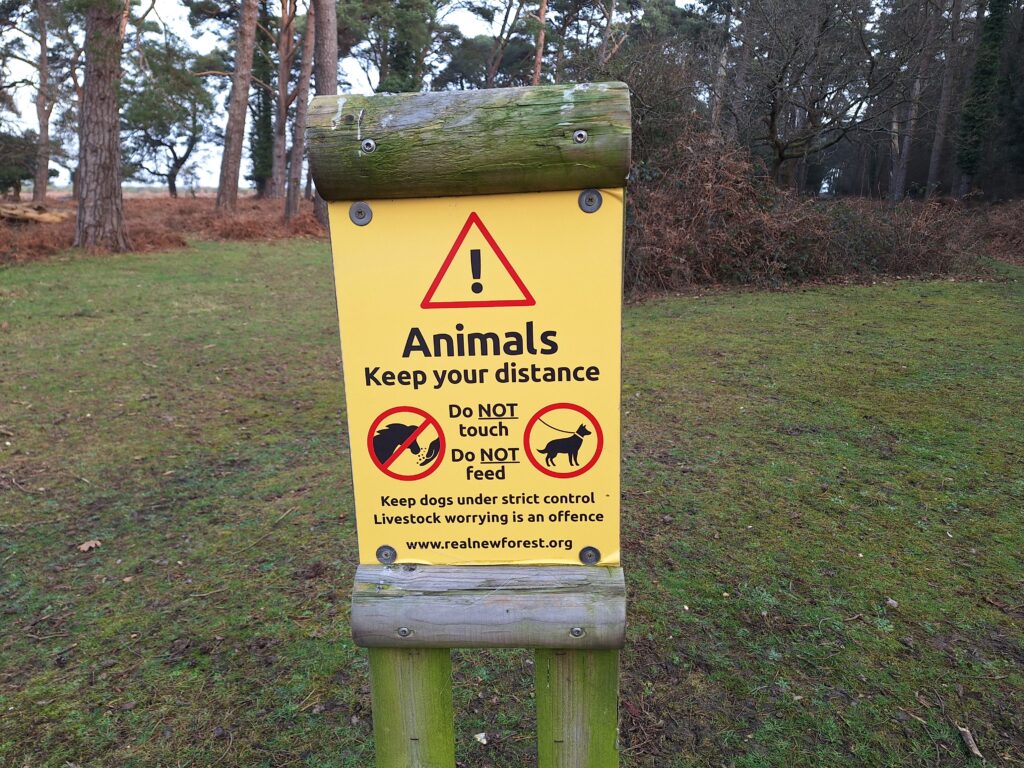
Keep your distance from animals sign
The problem with the large signs is that they have a habit of falling over, being trampled upon or being stolen. The surviving 20 or so are still used but now generally at pubs, etc. and off the Crown lands. The yellow ‘no feeding’ signs at the car parks are generally holding up okay and I was pleased to see that the Rangers look after them by cleaning them on their visits.
There are no plans at the moment to change or add what are out there now, but at some point we will have to decide on where we go with the signs. With incidents involving livestock, signs are all important.
The future difficulty is how much signage and where without ruining the character and look of the Forest.
Other signs that are being used are ‘slogan signs’. These were originally produced by Hampshire County Council to be fixed around different locations on their signposts and ‘rotated’ around to a seasonal timetable so that drivers would still be made aware of them without the message going stale.
These have now been used for about two years now and does require a lot of effort to keep moving them around. The CDA along with the great help of the Young Commoners are keeping this going and hopefully making an impact.
Fencing
In late 2020, I submitted a presentment to try to resolve the very poor fencing at Cadnam along the A337, as we were especially worried about our animals breaking through and wandering on to that busy road.
This led to further discussions about the general poor fencing throughout the Forest ‘A’ roads and a further presentment was submitted shortly after (during lockdown) on behalf of the CDA to completely replace the poor fencing along all the Hampshire County Council-controlled ‘A’ roads throughout the Forest with higher quality fencing.
A bit of persistence paid off and eventually HCC agreed to replace all this fencing with wooden post and rail/stock netting. Understandably, they didn’t have the funds to do it all at once but over a period of time.
Four years later, I’m pleased to see that large stretches have been replaced. The fencing is far more robust and stock proof and can better cope with fallen branches landing on it. Any breakages tend to be very localised to one top rail rather than pulling down a whole stretch of weak post and wire fencing.
Another benefit about this fencing is that it is highly visible from the road (and in my opinion more pleasing to the eye) and any damage can be quickly and easily seen and reported in comparison to the post and wire.
The only problem we will face in the future that I can see is that the wooden posts nowadays have poor quality preservation and can rot off at the base much faster than in the past (especially in wetter areas). It’ll be interesting to see how long these last before needing replacing.
The fact that the fencing is being replaced over a time means that at least it won’t all need doing at once! It’s good to see that HCC is taking this seriously and doing what it said it would do.
Future funding is uncertain though as councils are surviving on less and less money. We will have to wait and see what happens, and hope for the best.
Tony Vanderhoek, CDA Committee member
Other articles from CDA annual report
- Birch felling, track repairs and bridge battle among key issues on open Forest
- The ongoing challenge of encroachments for the New Forest CDA
- Campaigning continues to help reduce number of New Forest animal accidents
- New Forest Young Commoners: ‘A pivotal time to stand up, be counted and take action’
Andrew Parry-Norton outlined a number of key issues facing commoners in his monthly video update.
He talks about a report from New Forest National Park Authority member Brice Stratford looking into commoners getting recognition as a ‘national minority,’ as well as an upcoming visit by DEFRA officials and a meeting with Camping in the New Forest among other things.
Watch his video in full below or on the New Forest CDA’s Facebook page here
In case you missed any of Andrew’s videos from recent months, check them out below.
- March 2025 update
- February 2025 update
- January 2025 update
- December 2024 update
- November 2024 update
This is a report on Open Forest management, by New Forest CDA vice chair Robert Stride. It was first published in the CDA’s annual report for 2025.
CDA committee members Robert Stride, Keith Mansbridge and Brian Ingram attend the Open Forest Advisory Committee (OFAC) on behalf of the CDA and its members. OFAC discusses all of the major works on the open Forest which may or may not impact on our commoning activities.
A wide variety of works have been carried out in the last 12 months which benefit commoning and commoners. These include track and passageway repairs, wind blown trees across tracks, birch felling and vegetation management with the tractor mounted mulchers, which makes short work of even the oldest gorse.
Unfortunately, last season because of the wet winter and early spring, we were unable to get much of the burning programme done. The perennial question, ‘is the weather good enough to go burning?’, was upon us this year and we were out this spring on every day that allowed.
Contrary to many commoners’ beliefs, it isn’t really possible to burn before February. We are lucky that the burning teams are made up mostly of commoners who work as employees or contractors for FE, which gives us an added impetus to get the burning right.
One of the challenges we have faced this year have been the ongoing problems at Pennymoor which will need remedying this summer. The bridge has been removed and the passageway is non existent.
The CDA and Verderers representatives have insisted that a robust passageway needs to be constructed which is passable year-round for commoners and their livestock.
We have also had site meetings at Anderwood and Millyford Green. At Anderwood, we agreed to clearing more of the trees off the wet lawn and to rerouting the drain out of the inclosure through a piece of low lawn and back in to the culvert under the road.
The Millyford Green project was rejected as it was decided it would be detrimental to the existing remnants of lawn which would be permanently ‘rewetted’ by infilling the drain.
Bridges are a vital part of getting around the open Forest and this year we have had quite a battle to ensure critical bridges are retained. After quite a few meetings with the FE civil engineering team we have come to an agreement.
The bridges will be maintained to the current standards. However, as they do not come up to the standards required for horse riding bridges (high sides etc), it will be left to commoners and other horse riders to make their own risk assessment before using the bridges and to understand that they use the bridges at their own risk.
My greatest sadness is that there is not a system or funding in place to train the next generation of Forest workers, or the opportunity for them to gain experience working in the Forest. The current team were lucky enough to have been trained by previous generations of skilled craftsmen, which is critical as this is such a unique place and skills cannot be learnt in college or on a modern training course.
The CDA team are responsible for suggesting cut and burn sites to OFAC and for reporting any problems or issues to FE. Please get in touch if there are aspects of open Forest management that you feel should be addressed, or areas you feel would be good to add to the cut and burn programme.
Robert Stride
This report is from James Young, chair of the Encroachments Sub Committee and was first published in the New Forest CDA annual report for 2025.
It has been another busy year for the Encroachments Sub Committee and we receive excellent support from the Encroachments Working Group, which is now up and running again under the secretariat of Julie Stubbs with the support of the New Forest Association. All the original stakeholders have re-engaged and we go forward into 2025 with renewed enthusiasm and determination.
As is usual we have had reports of several new encroachments and these include a couple in Ashurst where the fences appear to have been moved and a heap of boulders and soil in Brockenhurst which is not only preventing access by stock but also could pose a danger to them.
Unfortunately, we are also investigating a serious encroachment by a commoner at Minstead involving over 300 metres of fence moved out from the original. This will have to be resolved because it involves a much larger area of land lost than on a standard garden encroachment.
Inevitably, several long-standing encroachments remain on file and we are desperately trying to encourage the Highways Authority to get involved in our group to try and bring these to a conclusion. This is because not only have the fences been moved out from the original but they are now so close to the metalled surface that they present a hazard to road users.
It is not all gloom and doom, however. A new fence was under construction at Holmsley when we were alerted to the problem. The landowner proved most helpful and involved us at all stages when the hedge was cut back severely and the new fence as far as possible replaced on the line of the original.
Encroachments are such an important part of the work the CDA does and are not something that we can deal with on our own, so we look forward to further successes on all fronts as well.
James Young, chair of Encroachments Sub Committee
Foal season is almost upon us, meaning the first of the New Forest foals will be emerging over the next few weeks.
The foals are the offspring of the stallions turned out last summer which means they are both sired and born on the Forest.
The foals’ arrival coincides with the spring grass and it is hoped that this, along with better weather, will provide them with the best conditions to develop and thrive.
This signals an important time of year for New Forest commoners, with the majority of the ponies out on the Forest pure-bred with bloodlines that span generations.
It forms a small but significant part of the rich history and culture of New Forest commoning and commoners, who play a hugely important role in managing the landscape.
If you’re enjoying the National Park, please be extra cautious around grazing animals and in particular the foals given their unpredictability and lack of road sense.
Stallions will be released on the New Forest for a six-week period this summer.
A total of 21 have been chosen and will be turned out to breed with the free-roaming mares from Monday, 12 May.
A select number of stallions are let out each year to help maintain the New Forest pony bloodlines and control the number of foals born each year.
The stallions are chosen based on their type, conformation and temperament.
Kerry Dovey-Whiting, who helped judge the stallions for the New Forest Pony Breeders and Cattle Society, explains the background behind the judging. “It is really important the colts are inspected, as one colt or stallion can sire up to 40 foals, so if you permitted a stallion with a conformational defect to breed, that fault can be passed on to lots of ponies,” she says.
“It is vital for the New Forest pony breed that there are new foals each spring to prevent numbers decreasing and the breeding mare stocks to dwindle. The ponies’ grazing helps to keep the natural ecology balance on the Forest.”
Since 2010, the New Forest Higher Level Stewardship (HLS) scheme has provided funding for back-up grazing for up to 30 stallions each year. The scheme is a partnership between the Verderers of the New Forest, Forestry England and the New Forest National Park Authority.
This funding encourages commoners to own stallions and ensures they have land to graze on during the long period when they are not permitted to be on the Forest. From the pool of 30, a number are released each year.
Members of the public are warned not to approach the stallions and to keep their distance from them. Dogs should be kept on lead and drivers are being urged to take extra care across the Forest.
This is an update on animal accidents in the New Forest from Gilly Jones, who is chair of the Animal Accidents Reduction Group and who leads the New Forest Roads Awareness campaign over social media.
The report was first published in the New Forest CDA annual report for 2025.
We are hoping that all commoners will be thankful that the livestock deaths are again coming down. The year 2024 saw the lowest numbers of livestock fatalities in history. The start of 2025 hasn’t been too good, so we all need to up our game.
Commoners had 37 animals killed on the roads in 2024, down from 42 in 2023. If we go back to 2014, 68 animals died.
There are many reasons for this, including Operation Mountie, a multi-agency working group which includes commoners, Forestry England and National Park rangers, NFDC staff and obviously Hampshire Police do an anti-speeding session once a month. We also do extra Operations as and when collisions happen.
There is also a huge amount of work done by commoners, CDA and the Young Commoners on social media.
Out of the 22 pony deaths in 2024, only three had collars on. We have no way of knowing how many livestock lives have been saved by animals that have been fitted with them, but the numbers will be huge.
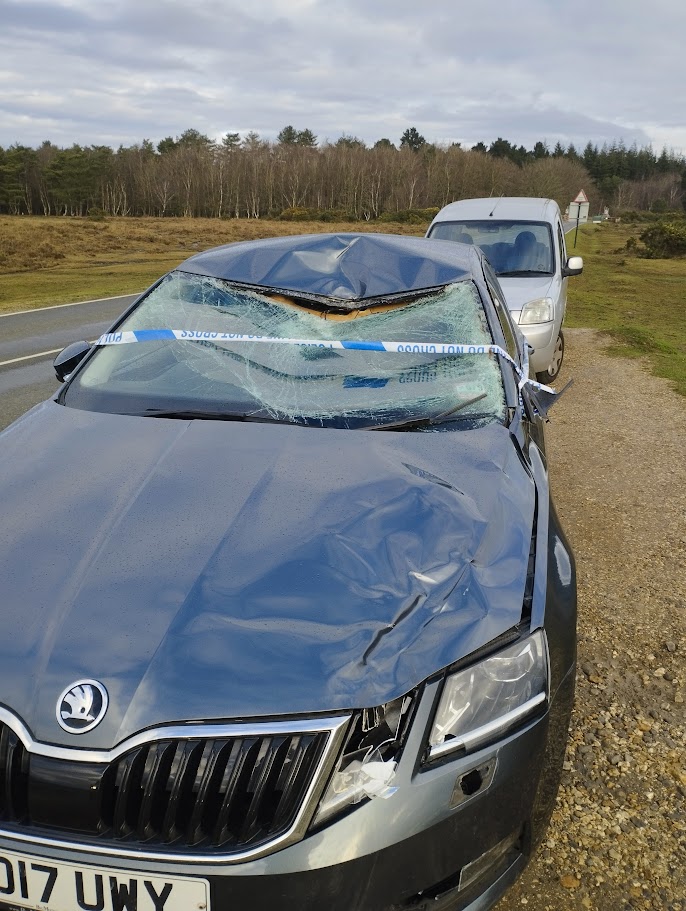
The after effects of an animal accident in the New Forest
Dartmoor is now following the New Forest and fitting its livestock with them. There is work going on to find ones suitable for donkeys. I know some commoners think the collars are dangerous, but I hope that they will rethink it.
Please lead by example and drive with care around the Forest and when dealing with the livestock. Everyone has a video camera on their phone and we are under a huge amount of scrutiny.
Speed is not always the reason for a collision, and again we are working on your behalf to educate drivers. All our social media pages are slowly turning the tide and getting the public to know, like and trust commoners.
We have worked with Hampshire Police to make sure all call centre staff are fully trained in how to deal with a livestock collision call.
I am hoping that 2025 will get better, and I will carry on working as hard as I can to reduce the number of collisions.
Gilly Jones, chair of New Forest Roads Awareness
New Forest CDA chair Andrew Parry-Norton made two presentments in front of Verderers at their April open court session.
The first presentment thanked Forestry England for ‘a very successful burning season’ while the second was a counter presentment following a suggestion at the March court that pony numbers in the Forest have increased.
Andrew also talked about pony welfare to the court, and urged anyone who sees a poorly animal to report it to the Verderers.
You can read both presentments, heard on Wednesday, April 16, in full below.
See below for New Forest CDA presentments at Verderers’ Court from recent months.
Members Login
 Latest Tweets
Follow us

@realnewforest 4h
Icilibus sam quas aut eriatem nume corepta auta conet officaborem quodi corepta auta conet officaborem quodi apernat ectlpa dolorpiaecus.
@realnewforest 4h
Icilibus sam quas aut eriatem nume corepta auta conet officaborem quodi corepta auta conet officaborem quodi apernat ectlpa dolorpiaecus.
@realnewforest 4h
Icilibus sam quas aut eriatem nume corepta auta conet officaborem quodi corepta auta conet officaborem quodi apernat ectlpa dolorpiaecus.
 Join us on Social

Tag your images #RealNewForest
With thanks for support from