From drought to deluge: Head agister reflects on how New Forest Commoners’ livestock coped during challenging year
This article by Head Agister and New Forest CDA committee member Jonathan Gerrelli was first published in the CDA’s annual report for 2025.
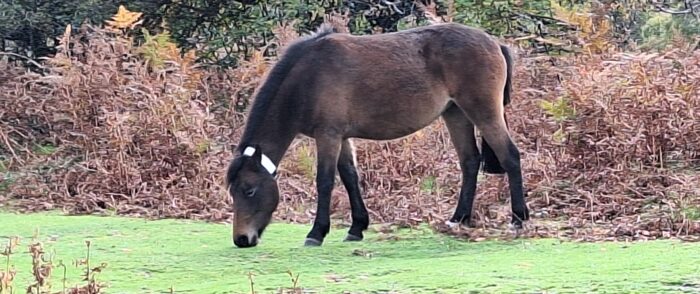
Over the past year the New Forest has experienced a number of extremes with regards to the weather, from near drought conditions in the summer to record levels of rain this winter, and this of course impacts on the stock.
Not only because of the effect it has on the amount of forage available on the Forest but also how it reduced the crop of hay and silage, leading to much higher prices. However, what it has shown once again is how resilient the Forest is and how lucky we are.
During the driest time there were still the bogs and wet areas that stock could get into to feed while our fields were brown and burnt up, and through the winter when you see animals in fields stood in mud with no shelter, the Forest stock can always find somewhere dry and a good gorse break to get behind.
Despite the weather, the stock have coped fairly well and although there are always some animals that lose condition and need to come in, so far we are not having to remove large numbers, but we still have some time to go.
Remember the Forest is always the last place the grass grows!
As for the drifts, they don’t get any easier. In the early ones we had to deal with the dry hard ground and the heat, and add to that the ever-increasing number of people out there and the safety precautions we have to put in place, it becomes more and more difficult.
I would like to thank all the people that help out to make the drifts possible, especially the Forestry England ranger team and the keepers that shut car parks and attempt to manage the public on our behalf, and of course Gilly Jones who travels miles putting up the drift warning signs.
The drifts are a vital part of the management of the ponies and we must continue to do all we can to ensure they are as successful as possible.
The welfare tours went ahead in the spring and again in the winter and are an important part of our working with other groups and an opportunity for us to explain how the Forest works and the processes we have in place to deal with any issues that arise with the stock.
We also have had several meetings with APHA (Animal and Plant Health Agency) to discuss and update the TB (Tuberculosis) plan that is so important to enable cattle Commoners to continue to turn cattle out.
The pannage season was extended in 2025 due to the large crop of acorns, and I did fear that we would suffer more losses due to acorn poisoning than we did.
Poor boundary fencing is an ongoing issue for all stock but is especially found out by the pigs, and more needs to be done to remind property owners they are responsible for maintaining a stock proof fence.
The only thing I have to say about the donkeys is that if you have them, keep checking their feet!
Members Login
 Latest Tweets
Follow us

@realnewforest 4h
Icilibus sam quas aut eriatem nume corepta auta conet officaborem quodi corepta auta conet officaborem quodi apernat ectlpa dolorpiaecus.
@realnewforest 4h
Icilibus sam quas aut eriatem nume corepta auta conet officaborem quodi corepta auta conet officaborem quodi apernat ectlpa dolorpiaecus.
@realnewforest 4h
Icilibus sam quas aut eriatem nume corepta auta conet officaborem quodi corepta auta conet officaborem quodi apernat ectlpa dolorpiaecus.
 Join us on Social

Tag your images #RealNewForest
With thanks for support from